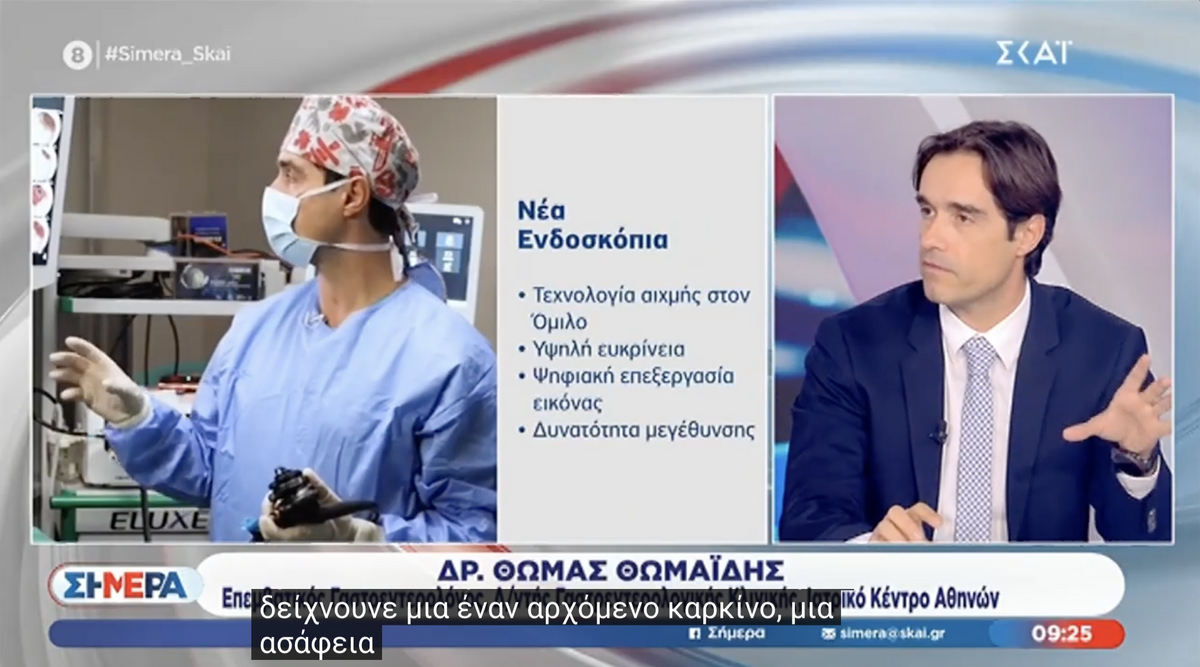
On the SKAI show “Simera,” Dr. Thomas Thomaidis talks about the new, revolutionary methods in endoscopy.
The methods in question
The “revolutionary methods” in endoscopy are specific techniques that have changed practice over the last decade. What they have in common is that they use the endoscope to treat lesions that used to mean surgery, with removal of part of an organ.
- ESD, endoscopic submucosal dissection. It removes large or flat lesions in a single piece, which allows accurate assessment of the margins and the depth of invasion.
- POEM, peroral endoscopic myotomy. Used for achalasia, it is performed through a submucosal tunnel and without an external incision.
- EFTR, endoscopic full-thickness resection, for lesions that involve the full thickness of the wall.
- Endoscopic ultrasound. It assesses the depth of invasion and allows fine-needle biopsy of lesions a few millimeters in size.
It is staging that determines the choice: when the lesion is confined to the superficial layers, endoscopic removal is oncologically sufficient and the organ is preserved.
Where it makes a difference for the patient
The practical significance lies not in the technique itself but in what is avoided. In the past, a large lesion in the rectum could mean removal of part of the bowel and, if it was located low, a permanent stoma. An adenoma of the papilla of Vater could mean a Whipple procedure, that is, removal of part of the pancreas and the duodenum. With the corresponding endoscopic treatments, the patient usually goes home within one to two days.
The limit is clear, and it is set by staging: when invasion extends beyond the superficial layers or there is a risk of spread to the lymph nodes, surgical treatment remains the right choice. Endoscopy does not replace surgery – it limits it to those who truly need it.
Frequently asked questions
Send us your request
Fill in your details and we will contact you to schedule your appointment.
Content last updated: October 2026 (12/10/2026).